A bed that lifts over your desk
If you have searched for a murphy bed with a desk, you have met the compromise: the desk folds up into the cabinet so the bed can come down, which means clearing it every night. A motorized platform works the other way round. The bed goes up and the desk stays a desk — set up, in the same place, with your work still on it.
The problem with a murphy bed and a desk
The murphy-bed-with-desk is a clever piece of engineering: a desktop hinged into the cabinet so that it swings up out of the way as the bed swings down. Thousands of people live with one happily.
But look at what it asks of you. The desk has to be empty before the bed can come down — not tidy, empty. Laptop closed and moved, monitor off the surface or mounted separately, papers away, lamp lifted. That is a ritual twice a day, and the failure mode of every fold-away is not mechanical: it is the week you stop doing it, and the bed stays up, and the room becomes an office with nowhere to sleep or a bedroom with nowhere to work.
There is a second cost. The desk is part of the cabinet, so it is the depth and width the cabinet allows. If you work on two screens, that is usually the wrong desk.
What happens instead
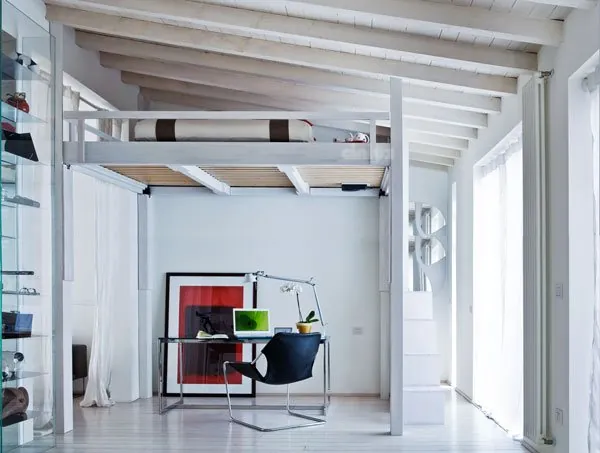
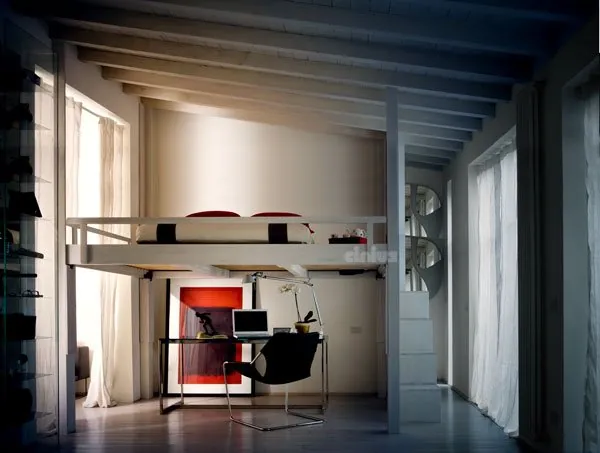
Our beds move vertically on a motor. During the day the platform sits high and the floor underneath is a room: desk, chair, bookshelf, whatever you put there. At night the platform comes down to sleeping height. Nothing folds, nothing is carried out of the way, and the bed stays made with a normal mattress on it.
The desk is also just a desk — yours, the size you need, where you want it. We draw the bed around it rather than building it into a cabinet.
Two models do this, and they differ in how they stand rather than in what they do. Rising runs on four solid beech columns between floor and ceiling, which means it can sit anywhere in the room and be made to measure, including wider than the mattress. Cloud runs on two tracks fixed to the wall, with legs that come down to the floor when the bed descends, so the middle of the room stays clear — but it comes in standard mattress sizes rather than made to measure.
The 59 inches that decide it
One number decides whether a desk under a bed is pleasant or a thing you avoid: the clear height from the floor to the underside of the platform.
Work it up from the chair, not down from the ceiling. A desk chair puts the seat about 18 in up. An adult between 5 ft 7 in and 5 ft 11 in sitting on it has the top of their head at roughly 50 to 52 in. Leave the few inches that separate “above my head” from “at my head” and you land near 59 in. That margin is not fussiness: it is the difference between leaning back in your chair and checking first.
Now the reason a fixed loft bed cannot give you that under an ordinary ceiling. Above the mattress you need at least 30 in of clear space to sit up, which is the US Consumer Product Safety Commission's recommendation for loft and bunk beds. Add the mattress and the platform, then 59 in underneath, and you are asking for more than nine feet of ceiling. A moving platform never has to satisfy both at once, because you are not at the desk while you are asleep.
| Ceiling | Raised working hours | Lowered night | Desk underneath? |
|---|---|---|---|
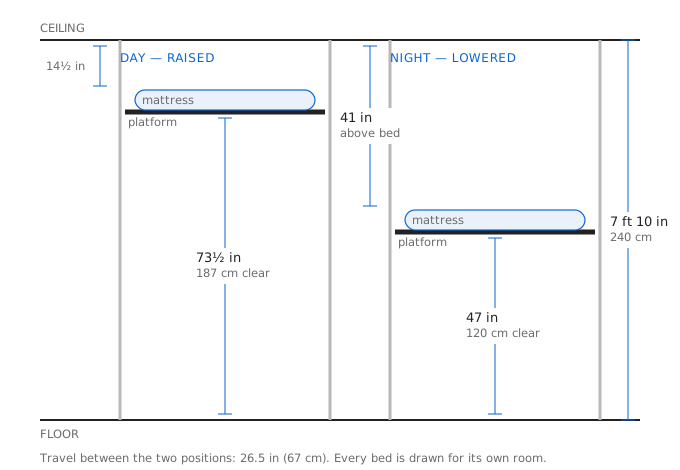
| 7 ft 10 in 240 cm | 73½ in | 47 in | Yes, 14 in to spare |
| 8 ft 10 in 270 cm | 83½ in | 57 in | Yes, standing room |
| 9 ft 10 in 300 cm | 89½ in | 63 in | Yes, full standing |
We quote 8 ft as the practical minimum: the lowest build is drawn for 7 ft 10 in, and apartments rarely measure what the floor plan says. The whole arithmetic, including where in the room to take the measurement, is in what ceiling height a loft bed needs.
Rising or Cloud, for a desk
For a desk specifically, Rising is usually the answer. Made to measure means the platform is drawn around your desk and your ceiling, and the four columns let it stand where the desk already is rather than only against a wall.
Cloud suits the case where the floor must stay completely clear during the day and the room is a living room first — it is the bed that comes down over a sofa. If that is closer to your situation, look at Cloud on the homepage and tell us which room it is.
What can stay on the desk
This is the question people ask on the phone, and it deserves a straight answer rather than a slogan.
Nothing has to be folded away or dismantled — that part is unconditional, and it is the real difference from a fold-away. Whether a specific object can stay standing on the desk overnight is a matter of inches, and it depends on your ceiling. At the lowered height the clear space is 47 in at a 7 ft 10 in ceiling and 57 in at 8 ft 10 in. A 27-inch monitor on a stand reaches roughly 50 in from the floor on a 29-inch desk: fine in the second case, not in the first.
So we measure the tallest thing on your desk when we draw the bed, and the drawing shows the clearance before anything is built. If the monitor is the problem we will say so, and usually a wall or arm mount solves it — or the platform is drawn a few inches higher at the cost of headroom above the mattress, which is a trade we will show you rather than make for you.
If what goes underneath is storage rather than a workspace, the numbers are friendlier: see a bed with a wardrobe underneath.
Send the room and the desk, we will draw the clearance
Room width, length, ceiling height, desk height and the tallest thing on it. You get back a dimensioned drawing with a quote, free, and a straight answer if it does not work.
Common questions
Do I have to clear the desk before lowering the bed?
Nothing folds and nothing is dismantled — the desk stays set up and the bed stays made. Whether a particular tall object can stay standing is a matter of inches, so we measure the tallest thing on your desk when we draw the bed and show you the clearance. A murphy bed with a desk works the opposite way: the desk folds into the cabinet, so it must be empty every night.
How much clear height do I need for a desk underneath?
About 59 in to the underside of the platform. A seated adult's head is 50 to 52 in off the floor, so 59 in keeps the structure above your head instead of at eye level.
Will it work with an 8 ft ceiling?
With a moving platform, yes — 73 in during the day at a 7 ft 10 in ceiling, against the 59 in a desk needs. A fixed loft bed at the same ceiling leaves under 4 ft below, which is storage height, not desk height.
Is it safer than a fold-away bed?
It is a different mechanism: no gas pistons or spring counterweights holding a mattress vertical, just a solid beech platform on a motor, anchored to the wall. Rising is rated to 1,100 lb and Cloud to 440 lb.
Can two people sleep above a home office?
Yes — both take a queen, and Cloud also takes a king. A queen covers about 33 square feet, which in a one-room apartment is the whole difference between having a workspace and not having one.